Sunday, August 2, 2015

CA7- Copán, Honduras

I was the first one to check in at Copán, Mayan ruins that are over 3,000 years old.  
Copán is the name of the ruins, whereas Copán Ruinas is the name of the town (nothing else would make sense).  
Although the guides were pushing paying an extra 15$ to enter the tunnels (the entry ticket was 15$ as well), they were also pushing themselves (a guide would have been another 30$).  In other words, the day would have cost me 60 pupusas, or 2 Guatemalan border fines, depending on how you look at it.  
I almost waited for a group to get a reduced rate but when I saw hordes coming I panicked, and practically ran to the park entrance.  I decided to enter on my own and have the park to myself for a little while (I could always go back for a guide if I wanted).

Scarlet Macaws are found everywhere in ancient Mayan monuments, but as of now their numbers have declined.  These scarlet macaws were bred in captivity and released into the wild here at Copán (but are soon to fly with a flock and live a normal bird life).

According to Mayan legends, when warriors died they were transformed into butterflies.
I think he would make a beautiful butterfly.

Here I am in the middle of the Great Plaza.  Since structures built by new rulers were constructed on top of the existing ones, who knows what lies beneath this pyramid.

Jaguars were revered by Mayans, but now, due to loss of habitat, there are hardly any jaguars (if any) left.  I am kind of glad there isn't a jaguar release program like there is for the scarlet macaws.

Throughout the Great Plaza are stelas created to glorify their leaders.

I am standing on one side of the ball court.  This ball court is one of the largest in Central America.
Players were likely to be using hallucinogens, and had to prevent a large rubber ball from touching the ground.  It was played simply for entertainment; the losers (and sometimes the winners) were sacrificed afterwards to the Mayan gods.
Who wants to play?


Full of information about the battles won by Copán kings, among other important information, this stairway is the single largest collection of hieroglyphs in the Americas.  There are over 2,000 hieroglyphs on 63 steps.


I love seeing the roots of the trees incorporated into the Mayan site.  
This is not how it would have looked thousands of years ago.  The decline of this specific civilization was most likely due to deforestation, which lead to drought and crop failure and resulted in hunger, disease, and political unrest.


At one time Copán extended for two km along the Copán river, just beyond the steps in the distance is where there was once more territory.  The Copán river undercut this area (known as the Acropolis) causing many buildings to collapse.  The river has since been diverted.


Lizard glamour shots.

This area is called the Cemetery because of skeletal remains that were found here.  In actuality it is the location where the Copán elites lived.  It was common practice to be buried next to your home, which makes not visiting your deceased relatives unforgivable.


Since I had no guide it gave me lots of opportunity to sit in areas, like the Cemetery, with no one else around, and enjoy Copán.  

I spent over two and a half hours inside the park, trying to avoid people (which shows in my pictures) but this is what it actually looked like...

Business is picking up, more lizard glamour shots!
Before completely exiting the archaeological site I saw a sign for a nature trail and decided to partake.  I figured no one would be on it, and I was right.

I love the yellow antennae on this butterfly.  

After I got back I played the banjo, and my biggest fan Cristal (a hotel employee's daughter) sat with me the whole time.  She was fascinated, to say the least.  As time went by she got more and more bold; at first pretending to play the piano on the table, then touching the banjo while I was playing, as well as putting her face three inches from the strings to watch them vibrate.  
She eventually asking me if she could try.


Saturday, August 1, 2015

CA6- Juayúa a Copán Ruinas (por Guatemala)

I was on the bus to Santa Ana just before 6am.  The fastest way to get to Copán Ruinas in Honduras is to go through Guatemala, so I did.
Juayúa-Santa Ana.  One hour, thirty minutes.  80 cents.

Adios plantas de café .  Adios montañas.

Luckily I asked the conductor 'donde puedo encontrar el autobus que va a Metapán' because after everyone disembarked he drove me to the bus, just a few minutes away.  But the moment I got on we left.  
Santa Ana-Metapán. One hour, forty minutes.  80 cents.

Usually the workers that board the bus are selling things like candy, and food, and drinks, and medicine, but these young men played music, a song called Libertad.  It was great, totally worth the 20 cents I gave them (once again, super generous).

After arriving in Metapán I only had to wait 20 minutes for a bus to Anguiatú, la frontera de Guatemala.  The bus system is fairly easy, the places listed in paint on the front of the bus are accurate, and the drivers are helpful.
Metapán- Anguiatú.  35 minutes.  55 cents.

Before we left I bought a slice of amazing banana bread from this woman.  I know what you are thinking, when will banana bread ever catch on in the States?!

When I arrived at the El Salvadoran border there was hardly a line, but within five minutes a line had formed.

After checking in at the El Salvador border I walked to Guatemala and found a microbus that was going to Chiquimula.  (I wasn't going all the way there, just most of the way until the road that leads to the Honduras border crossing, El Florido.  As it turns out the microbus just took me to another microbus that was heading that way.  The microbus I am sitting on now paid the other microbus so I just had to pay once.
Anguiatú- Chiquimula.  Two hours.  20 quetzales.

The driver pulled over for about five minutes to watch a partido de fútbol.

As soon as I arrived at the turn off to El Florido there was a minibus waiting.  It wasn't long before we were on our way.
Chiquimula- El Florido.  One hour.  15 quetzales.

Okay, we pulled over and had to get out to take another minibus to El Florido (but I used the same boleto).

In between the last picture and this picture over an hour went by.  It is a long story but I will make it short, and will eventually admit my mistake.  When I tried to cross the Guatemalan border they asked me where my stamp was.  I said I didn't know because I don't work at the border, but they didn't give me a stamp.  He asked me to go into another room where I was told that because I didn't have a stamp I was going to have to go back to El Salvador.  I, of course, said no; that was not going to happen.  He said fine, then go to the Honduran border and see what they say.  When I walked to Honduras they asked me where my exit stamp from Guatemala was.  I said they didn't give me one, because I didn't have an entry stamp.  The Honduran customs agent said that I would have to talk to a lady who works at customs in Guatemala (the place that I had just came from, the place that told me to go back to El Salvador).  They took my passport and asked me to wait.  As I waited I seriously felt like breaking down and crying but I couldn't muster up any tears, so I just waited.  For an hour.  Totally tearless.  Retracing my steps back to El Salvador, wondering what time the border closed, etc, and why I was waiting.  Eventually the lady from the Guatemala border came and told me to leave my stuff and walk with her back to Guatemala.  She told me that I had to (and always have to) check in on both sides at the border.  She told me about ten times, just so I was clear.  She explained to her coworkers that I made a mistake and told me I had to pay a multa (30$, much better than traveling back to El Salvador which would have taken a minimum of seven hours round trip).  I thankfully paid, kicking myself.  
What happened?  I was thrown off by something I read.  When arriving in El Salvador I paid 10$ for a 90 day visa, valid in El Salvador, Guatemala, and Honduras.  So I didn't think they were going to stamp my passport.  It was a stupid mistake, but the multa in Honduras would have been higher so I am glad it happened in Guatemala.
So, just so everyone is clear, check in at the exit point, and the entry point.  It is not that obvious since in between the exit and the entry you walk, and cross over bridges and... well, it was a stupid mistake.
El Florido- Copán Ruinas.  25 minutes.  65 lempira.

Not just for effect (since I already took three buses and five micobuses and crossed two borders) I took a tuk-tuk to my hotel in Copán Ruinas.  I took the tuk-tuk because the hotel is located a little outside of town, up a few steep, rocky hills. and after today I just didn't feel like lugging my stuff around.
El parque central- Casa Dona Elena.  5 minutes.  20 lempira.

I made it.

I hadn't had anything all day except banana bread so my first mission was food and coffee.

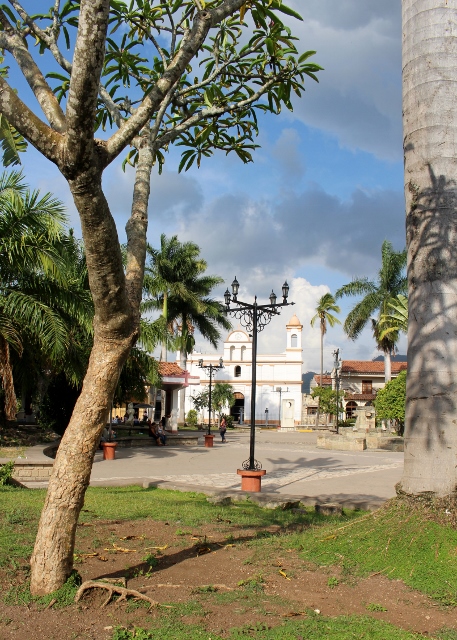
Copán Ruinas is a neat little town, with a very distinct central park.


My dinner at Pizza Copán was mediocre at best but my cappuccino at Café San Rafael was so incredible I forgot all about the pizza (that I gave away to some niños de la calle).


After walking back to the hotel I played the banjo on the roof.  One of the employees immediately came up to talk to me about the instrument, and to take pictures and video me while playing.  (So I asked her to take a picture with my camera...)
The banjo is a very foreign instrument in Latin America.  It is the second time I have been videoed at a hotel while playing.  Before I leave I am going to have a top hit in Latin America!  Or maybe a roof top hit, if nothing else.

Somewhere in my room is a gecko that I hope doesn't get bored and try to lick my eye in the middle of the night...